
The March of the Machines: A History of Humanoid Robotics
From bronze giants of myth to backflipping engineers of silicon and steel — humanity has spent 3,000 years trying to build itself a mirror.
Before There Were Robots, There Were Dreams
The idea of artificial humans is older than recorded history. In Homer's Iliad, the god Hephaestus forges golden handmaidens that can think, speak, and work. The bronze giant Talos patrols the shores of Crete, hurling boulders at enemy ships, powered by a single vein of divine fluid running from neck to ankle. These aren't just stories — they're engineering specifications written in myth.
By 50 CE, Hero of Alexandria had turned myth into mechanism. His programmable mechanical theaters used falling weights, ropes wound around axles, and grain-based timing systems to stage automated plays with moving figures. The sequence of movements was set by the pattern of strings on a drum — a genuine analog program, two millennia before computing.
In 1206, the polymath Al-Jazari published his Book of Knowledge of Ingenious Mechanical Devices, documenting 50 machines including a musical automaton band on a boat. Four mechanical musicians played drums and cymbals in rhythmic patterns determined by rearrangeable cams on a rotating drum. Change the cams, change the song. It was programmable. It was 1206.
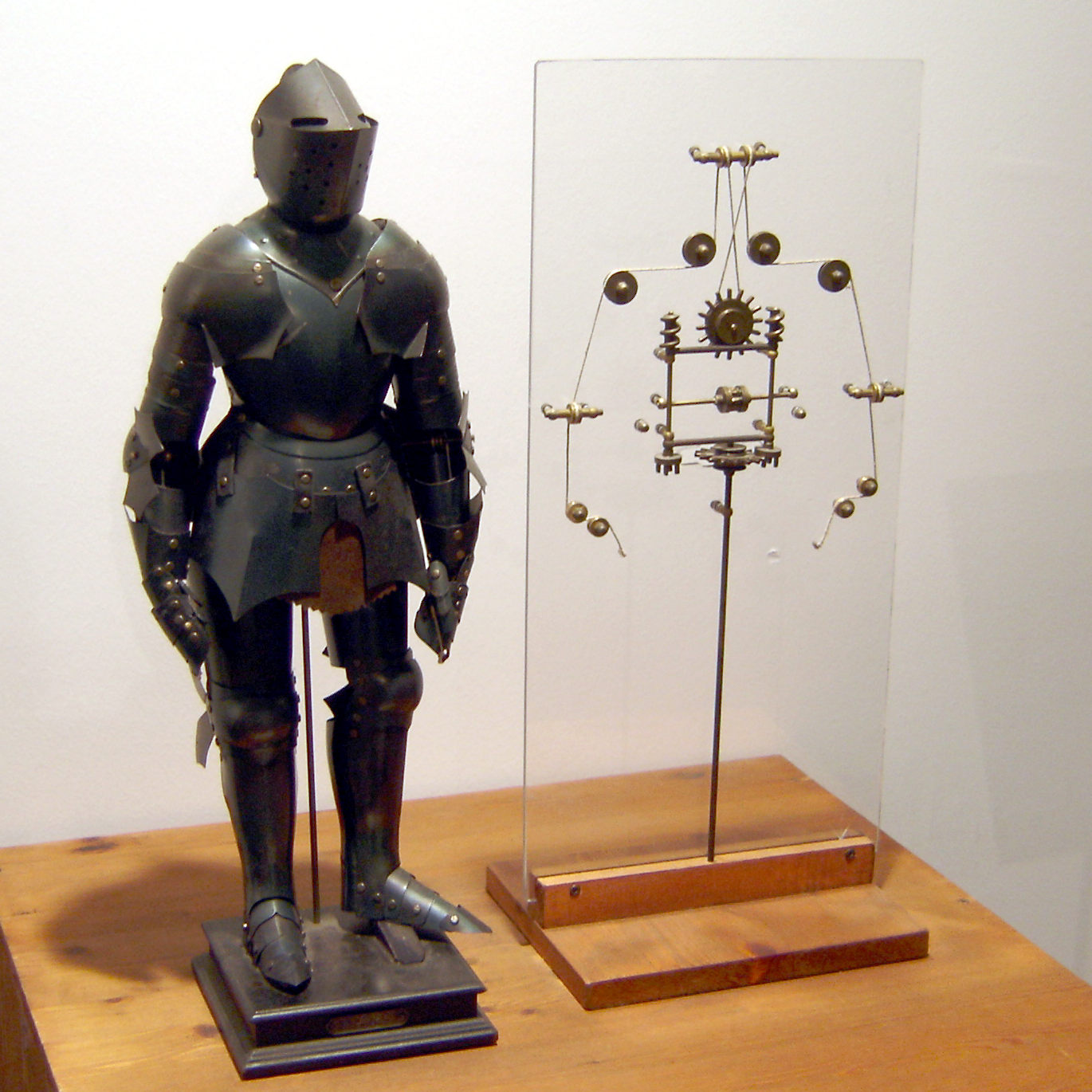
Around 1495, Leonardo da Vinci sketched a mechanical knight — a suit of Germanic-Italian armor driven by pulleys, cables, and gears. It could sit up, raise its visor, wave its arms, and move its jaw. Whether he built it is debated. In 2002, roboticist Mark Rosheim constructed a working model from Leonardo's scattered notebook pages. It functioned exactly as designed. NASA later consulted Rosheim's research for planetary rover designs. Five centuries between sketch and validation, and the engineering held.
The Golden Age of Automata
The 18th century was the age of the showman-engineer. In 1737, Jacques de Vaucanson unveiled a life-sized wooden flute player with working lips, a movable tongue, and articulated fingers that physically played a real transverse flute. It performed 12 melodies. The Académie des Sciences in Paris verified the music was genuinely produced by the mechanism — not a hidden trick.
Two years later, Vaucanson debuted his Digesting Duck: a gilded copper bird with over 400 moving parts in each wing. It ate grain, drank water, and appeared to digest and excrete. The "digestion" was a cheat — pre-loaded breadcrumbs from a hidden chamber — but the mechanical articulation was real. Voltaire quipped that "without the shitting duck of Vaucanson, there would be nothing to remind us of the glory of France."
Vaucanson later invented an automated loom using perforated cards — a direct ancestor of Jacquard's loom, which inspired Babbage's Analytical Engine, which inspired modern computing. The duck led to the computer. History is strange.

In Switzerland, watchmaker Pierre Jaquet-Droz and his son Henri-Louis built three automata between 1768 and 1774 that still function today, 250 years later. The Writer — a mechanical boy with 6,000 parts — dips a real quill in ink and writes any text up to 40 characters. The text is set by rearranging cams, making it programmable. His eyes follow the pen as it moves. Computer historians consider it an ancestor of the programmable computer. The Musician plays a custom organ with her actual fingers — not a music box — while her chest rises and falls as if breathing. The Draughtsman draws four different images and periodically blows on the paper to clear graphite dust.
Meanwhile, in Japan, the karakuri tradition was producing its own marvels. The most famous: a tea-serving doll powered by wound whale baleen. Place a cup on its tray and it walks toward your guest. When the guest lifts the cup, it stops. Replace the cup, and it turns and walks back. Master craftsman Tanaka Hisashige built an archer doll that could nock, draw, and fire arrows — with occasional deliberate misses programmed in for dramatic tension. Tanaka later founded what became Toshiba Corporation. The line from mechanical puppets to one of the world's largest electronics companies is direct.
"The product of the human brain has escaped the control of human hands. This is the comedy of science."
The Word That Changed Everything
On January 25, 1921, a play premiered at the National Theater in Prague that gave the world a new word. Karel Čapek's R.U.R. (Rossum's Universal Robots) featured mass-produced artificial beings built for labor who eventually revolt and exterminate humanity. Čapek originally considered "labot" from the Latin labor, but his brother Josef suggested "robot" — from the Czech robota, meaning forced labor or serfdom. Within three years, the play was translated into 30 languages.
A generation later, biochemist and author Isaac Asimov invented the word "robotics" in his 1941 story "Liar!" — believing it already existed. It didn't. He also formulated the Three Laws of Robotics in 1942, the most famous ethical framework for artificial beings ever written. His stories explore the logical edge cases of the Laws, not their failure. Real roboticists note the Laws are insufficient as engineering constraints — they depend on undefined terms like "harm" — but they remain the starting point for every serious conversation about machine ethics.
Steel Giants and Stumbling Steps
In 1939, a seven-foot, 265-pound aluminum humanoid named Elektro took the stage at the New York World's Fair. Built by Westinghouse, it could walk, move its arms, count on its fingers, speak 700 pre-recorded words, and smoke cigarettes. Its "voice recognition" was a telephone relay that counted syllables — different numbers triggered different actions. After the fair, Elektro landed a role in the 1960 B-movie Sex Kittens Go to College. Its head was later found in a basement in Mansfield, Ohio, and now sits in the local memorial museum.
The real work was harder. Making a machine walk on two legs turned out to be one of the most difficult engineering problems ever attempted. In 1968, Serbian researcher Miomir Vukobratović developed Zero Moment Point theory — the mathematical framework that defines when a bipedal robot is balanced. This theory would later underpin virtually every major walking robot, including Honda's ASIMO.
In 1973, Waseda University in Tokyo unveiled WABOT-1 — the first full-scale humanoid robot. It could see, hear, speak Japanese, grasp objects, and walk (each step took 45 seconds). Its mental faculty was estimated as equivalent to a one-and-a-half-year-old child. It was ugly, slow, and groundbreaking — the first machine to integrate all four pillars of humanoid robotics: perception, communication, manipulation, and locomotion.
"I happen to believe that robotics will be bigger than the Internet. The Internet lets every person reach out and touch all the information in the world. But robotics lets you reach out and touch and manipulate all the stuff in the world."
Honda's Secret Marathon
In 1986, Honda — a car and motorcycle company with zero robotics experience — launched a secret humanoid research program. No announcement. No timeline. Just an open question: can we make a machine walk like a human?
The E-series (1986–1993) was legs only. E0 could barely shuffle — each step took five seconds. By E6, the robot walked up and down stairs. Seven years of incremental progress, entirely hidden from the public.
Then came the body. P1 (1993) was Honda's first full humanoid: 6'2", 386 pounds, tethered to external power. P2 (1996) was the bombshell — self-contained, battery-powered, walking up stairs wirelessly. When Honda revealed P2 at a press conference in December 1996, the global robotics community was stunned. Nobody outside the company knew the program existed. P3 (1997) shaved 38% off the weight, approaching human proportions.
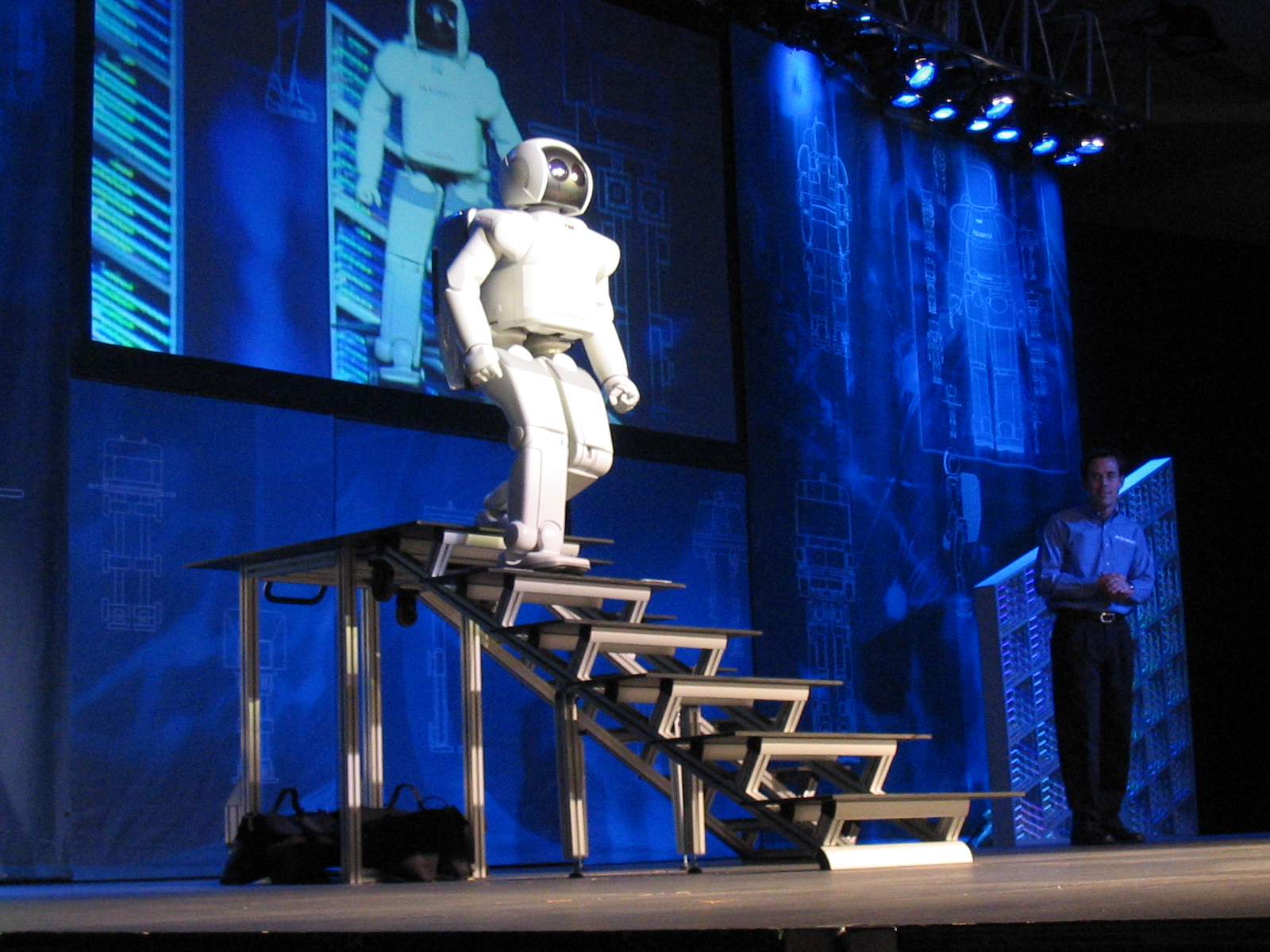
On October 31, 2000, Honda unveiled ASIMO — 4 feet tall, 115 pounds, deliberately child-sized to seem approachable. Over the next decade, ASIMO learned to run (9 km/h by 2011), pour drinks, hop on one foot, communicate in sign language, and coordinate with other ASIMO units. It met world leaders, conducted orchestras, and kicked a soccer ball with President Obama.
Honda never sold a single ASIMO. It was always a research platform and brand ambassador. The program ran for 22 years and cost an estimated $100 million before Honda retired it in March 2022. ASIMO proved that a bipedal humanoid could be reliable enough to operate in unstructured human environments. Its smooth, natural gait remained the benchmark for years.
Sony made its own run. QRIO — 23 inches tall, 16 pounds — became the first bipedal robot to run in December 2003, beating ASIMO to the milestone. Sony killed the program in 2006 during cost-cutting, alongside AIBO (which had sold out its initial 3,000-unit run in 20 minutes at $2,000 each). QRIO's cancellation remains a cautionary tale about corporate short-termism in robotics.
"Because of the risk inherent in trying to increase their degree of human likeness to scale the second peak, I recommend that designers instead take the first peak as their goal, which results in a moderate degree of human likeness and a considerable sense of affinity."
The Valley and the Mirror
In 1970, roboticist Masahiro Mori published a short essay in an obscure Japanese journal called Energy. Almost nobody read it. The essay described how human emotional response to a robot rises steadily as it becomes more human-like — then plunges into revulsion as it almost but doesn't quite achieve perfect likeness. He called this dip the Uncanny Valley.
The concept went unnoticed for decades. It wasn't officially translated into English until 2012. Today it shapes not just robotics but video game design, CGI filmmaking, and prosthetics. Mori's recommendation — aim for stylized, not photorealistic — continues to influence every humanoid robot designer.
At the other extreme: Hiroshi Ishiguro of Osaka University builds robots that look exactly like specific humans. His Geminoid HI-1 is a replica of himself. In 2017, Saudi Arabia granted citizenship to Sophia, a Hanson Robotics humanoid modeled after Audrey Hepburn — the first robot to receive legal personhood. The irony was sharp: Sophia appeared without a headscarf or male guardian's permission — rights human Saudi women didn't fully enjoy at the time.
Atlas Shrugs
Boston Dynamics was founded in 1992 as an MIT spin-off by Marc Raibert. Atlas arrived in 2013, born from DARPA's Robotics Challenge — a competition to build disaster-response robots inspired by the Fukushima nuclear meltdown. The 2015 DRC Finals became famous for spectacular robot fails: machines face-planting after opening doors, toppling off stairs, walking into walls. Team KAIST from South Korea won with a clever trick — their robot could kneel and drive on wheels at its knees, dodging the balance problems that plagued bipeds.
Atlas kept learning. By 2016, it was walking through snow and recovering from being shoved with a hockey stick — a video that went massively viral. By 2018: parkour. By 2021: a full parkour course with backflips and synchronized routines. Tens of millions of YouTube views per video.
The hydraulic Atlas was extraordinary but impractical — deafeningly loud, enormously expensive, and not commercially viable. Boston Dynamics retired it in April 2024, then unveiled the all-electric Atlas the next day. The electric version can rotate its joints beyond human range — its head turns 360 degrees. It's designed for actual deployment in Hyundai's automotive factories (Hyundai bought Boston Dynamics in 2021 for $1.1 billion).
"I've been saying for a long time that humanoid robots are a mistake. If it looks vaguely human, people are going to expect it to have human-ish capabilities."
The Cambrian Explosion
Something snapped in 2022. The combination of mature bipedal locomotion research, powerful AI models, affordable actuators, and massive venture capital created a chain reaction. The number of serious humanoid robot programs went from a handful to dozens in under three years.
Tesla revealed Optimus at AI Day in September 2022 — first as a person in a robot suit (widely mocked), then as a stiff prototype that could barely wave. By December 2023, Gen 2 was 30% faster, 10 kg lighter, and could handle eggs without breaking them. Tesla's edge: its neural network infrastructure from Full Self-Driving and its manufacturing scale. Elon Musk's target price: under $20,000.

Figure AI, founded in 2022, raised $675 million in February 2024 at a $2.6 billion valuation — investors included Microsoft, OpenAI, Jeff Bezos, and NVIDIA. By September 2025, the valuation hit $39 billion — a 15x increase in 18 months. Their Figure 01, powered by OpenAI's multimodal models, held a natural conversation while handing an apple to someone who asked for "something to eat," explaining its reasoning aloud. Figure 02 completed a 20-hour continuous shift at BMW's Spartanburg, South Carolina plant.
Agility Robotics opened RoboFab in Salem, Oregon — the world's first factory for mass-producing humanoid robots, targeting 10,000 Digit units per year. Amazon began testing Digit in its warehouses.
Unitree took the DJI-for-drones approach: make it cheap. Their G1 humanoid starts at $16,000. Their H1 set the Guinness World Record for fastest bipedal humanoid at 7.4 mph. In 2025, MirrorMe's Black Panther II sprinted 100 meters in 13.17 seconds on live Chinese television. Usain Bolt's record is 9.58 seconds — robots are closing the gap.
UBTECH Robotics became the first humanoid robot company to IPO in December 2023, hitting a $5.5 billion market cap. Goldman Sachs revised their humanoid robotics market projection upward by 6x — from $6 billion to $38 billion by 2035, projecting 1.4 million unit shipments that year. Over 30 Chinese companies were actively developing humanoid robots by 2025.
The AI Moment
Before 2022, humanoid robots were controlled by hand-crafted code. Walking gaits were meticulously calculated. Manipulation was pre-programmed. Robots could only do what engineers explicitly told them to do.
Now, robots learn to walk through reinforcement learning — billions of trial-and-error steps in simulated physics environments, then transferred to real hardware. Domain randomization — scrambling friction, mass, and motor strength during training — makes the learned behaviors robust enough to survive the real world.
Large language models act as high-level planners. The robot sees through cameras, understands language through an LLM, reasons about tasks, and breaks them into executable steps. Google DeepMind's RT-2 was a landmark: a single model taking camera images and language commands as input, directly outputting robot actions. NVIDIA's Eureka used GPT-4 to write reward functions, enabling a simulated robot hand to spin a pen at human-level skill.
Toyota Research Institute demonstrated robots learning dexterous tasks from just a few human demonstrations using diffusion policy models — the same mathematical framework behind image generation tools, applied to robot movement.
"The reason why we have been building humanoid robots is to hold the mirror up to ourselves. We need a deeper definition of humanity."
Why Human-Shaped?
A reasonable question: why build robots that look like us? Wheeled robots are more stable. Robotic arms are more precise. Drones are more mobile.
The answer is infrastructure. The entire built environment — doors, stairs, hallways, countertops, tools — is designed for the human body. A humanoid robot can slot into human-designed spaces without modification. The form factor isn't vanity — it's compatibility.
There's also a cultural dimension. Japanese children grow up with Astro Boy and Doraemon, where robots are protectors and friends. Western audiences grow up with The Terminator and The Matrix, where robots are existential threats. Japan's Shinto tradition — holding that inanimate objects can possess spirits — makes the idea of a "living" robot culturally natural. Star Wars gave the West C-3PO and R2-D2 — the first unambiguously heroic robot characters in Western pop culture — and began narrowing the cultural gap.
Where the Sidewalk Ends
Every current commercial deployment — BMW, Amazon, Hyundai, UPS — involves robots performing specific tasks in controlled environments. They insert sheet metal. They move bins. They sort parts. None of them are general-purpose.
Industrial deployment is here now. Consumer home robots remain years away. The "robot butler" requires breakthroughs in generalization, safety certification, cost reduction, and trust.
The optimists point to cost curves (40% annual decline), AI capability curves (exponential), and investment ($3–4 billion in 2024 alone). The skeptics — notably Rodney Brooks, who has been right about robotics timelines more often than most — warn of a hype bubble.
Both can be right. The technology is real. The timelines are probably wrong. The direction isn't.
From Talos to Atlas, from whale-baleen tea dolls to reinforcement-learned parkour, from Čapek's robota to a $39 billion valuation — the story of humanoid robotics is the story of humanity staring into a mirror and slowly watching the reflection start to move on its own.
The mirror is moving faster now.
References
- Homer. The Iliad, Book 18. (~8th century BCE). Description of Hephaestus's golden handmaidens and the bronze giant Talos.
- Apollonius of Rhodes. Argonautica. (3rd century BCE). Primary literary source for the Talos myth.
- Hero of Alexandria. Pneumatica and Automata. (~50 CE). Documentation of programmable mechanical theaters and automata.
- Al-Jazari, Badi'al-Zaman. Kitab fi Ma'rifat al-Hiyal al-Handasiyya ("The Book of Knowledge of Ingenious Mechanical Devices"). (1206).
- Rosheim, Mark E. "Leonardo's Lost Robots." Springer, 2006. Reconstruction of Leonardo da Vinci's mechanical knight from notebook sketches.
- Vaucanson, Jacques de. Le Mécanisme du Flûteur Automate. (1738). Presented to the Académie des Sciences, Paris.
- Jaquet-Droz automata (1768–1774). Permanent collection, Musée d'Art et d'Histoire, Neuchâtel, Switzerland.
- Hosokawa Hanzo Yorinao. Karakuri Zui ("Illustrated Compendium of Karakuri"). (1796).
- Čapek, Karel. R.U.R. (Rossum's Universal Robots). Premiered January 25, 1921, National Theater, Prague.
- Asimov, Isaac. "Runaround." Astounding Science Fiction, March 1942. First explicit statement of the Three Laws of Robotics.
- Asimov, Isaac. I, Robot. Gnome Press, 1950.
- Mori, Masahiro. "Bukimi no Tani" ("The Uncanny Valley"). Energy, vol. 7, no. 4, 1970, pp. 33–35. English translation: IEEE Robotics & Automation Magazine, vol. 19, no. 2, June 2012.
- Vukobratović, Miomir and Juričić, Davor. "Contribution to the Synthesis of Biped Gait." IEEE Transactions on Biomedical Engineering, vol. BME-16, no. 1, 1969.
- Kato, Ichiro et al. "The WABOT-1: A Humanoid Robot." Waseda University, 1973.
- Honda Motor Co. "ASIMO Technical Information." 2000–2022.
- Honda Motor Co. "Honda Humanoid Robot Development History: E0–E6, P1–P3." Internal research program, 1986–2000.
- Sony Corporation. "QRIO: Sony Dream Robot." 2003–2006.
- Raibert, Marc et al. "BigDog, the Rough-Terrain Quadruped Robot." Boston Dynamics / MIT, 2008.
- Boston Dynamics. "Atlas: The World's Most Dynamic Humanoid." 2013–present.
- DARPA Robotics Challenge Finals. Pomona, California, June 5–6, 2015.
- Ishiguro, Hiroshi. Geminoid research, Osaka University.
- Hanson Robotics. "Sophia." First robot to receive citizenship (Saudi Arabia, October 25, 2017).
- Tesla, Inc. "Optimus: Tesla Bot." AI Day presentations, September 2022 and December 2023.
- Figure AI, Inc. "Figure Raises $675M at $2.6B Valuation." Press release, February 29, 2024.
- Agility Robotics. "Digit: Purpose-Built for Work."
- Agility Robotics. "RoboFab: The World's First Humanoid Robot Factory." Salem, Oregon, September 2023.
- Unitree Robotics. "H1 and G1 Humanoid Robots."
- Unitree H1. Guinness World Record for fastest bipedal humanoid robot, 7.38 mph, 2024.
- MirrorMe / Robot Era. "Black Panther II 100m Sprint." CCTV broadcast, 2025.
- Sanctuary AI. "Phoenix General-Purpose Humanoid Robot."
- UBTECH Robotics. Hong Kong Stock Exchange IPO, December 2023.
- Goldman Sachs Global Investment Research. "The Global Market for Robots Could Reach $38 Billion by 2035."
- Brohan, Anthony et al. "RT-2: Vision-Language-Action Models Transfer Web Knowledge to Robotic Control." Google DeepMind, 2023.
- Ma, Yecheng Jason et al. "Eureka: Human-Level Reward Design via Coding Large Language Models." NVIDIA, 2023.
- Chi, Cheng et al. "Diffusion Policy: Visuomotor Policy Learning via Action Diffusion." Toyota Research Institute / Columbia University, 2023.
- Breazeal, Cynthia. "Designing Sociable Robots." MIT Press, 2002.
- Brooks, Rodney. "Elephants Don't Play Chess." Robotics and Autonomous Systems, vol. 6, 1990.
- NASA Johnson Space Center. "Robonaut 2."
- NASA Johnson Space Center. "Valkyrie (R5) Humanoid Robot."
- ABI Research. "Humanoid Robots Market Inflection Point 2026–2027." Market forecast, 2025.