

Why Can an AI Solve Advanced Physics But Still Can't Fold a Shirt?
This week, Google DeepMind rolled out Gemini 4 Argon for Robotics, a general-purpose physical reasoning model that scores 87% on embodied reasoning benchmarks and can already drive manipulation tasks on Boston Dynamics' Spot. It's a genuinely impressive technical achievement, folding robot control, real-to-sim conversion, and physical world understanding into a single frontier model. Read the press materials and you'd think the age of capable household robots is finally at hand.
But set that announcement next to two other stories from the same news cycle and a more honest picture emerges. One piece asks why humanoid robots can sprint and box in competition yet still struggle with laundry folding, a task any ten-year-old manages without thinking. Another describes how Carnegie Mellon's Robotics Institute spent years, under Professor Howie Choset, developing a peg-in-hole docking technique for Northrop Grumman's Mission Robotic Vehicle, relying on haptic feedback and specialized sensing just to let a robot arm insert a peg into a hole in the vacuum of orbit. If a satellite-servicing robot needs that much engineering just for peg-in-hole, it's worth asking what '87% on embodied reasoning benchmarks' actually tells us about a robot's readiness for your closet.
This is the uncomfortable truth hiding inside robotics' current AI boom: reasoning and acting are not the same problem, and the industry keeps conflating progress on one with progress on the other. A model that can look at a cluttered room and correctly infer the physics of how objects will fall, slide, or deform is doing something cognitively remarkable. But translating that inference into millimeter-precise finger movements, through a body with backlash in its gears, slip in its grippers, and sensors that drift, is an entirely different engineering discipline, one measured in friction coefficients and failure rates rather than benchmark percentages.
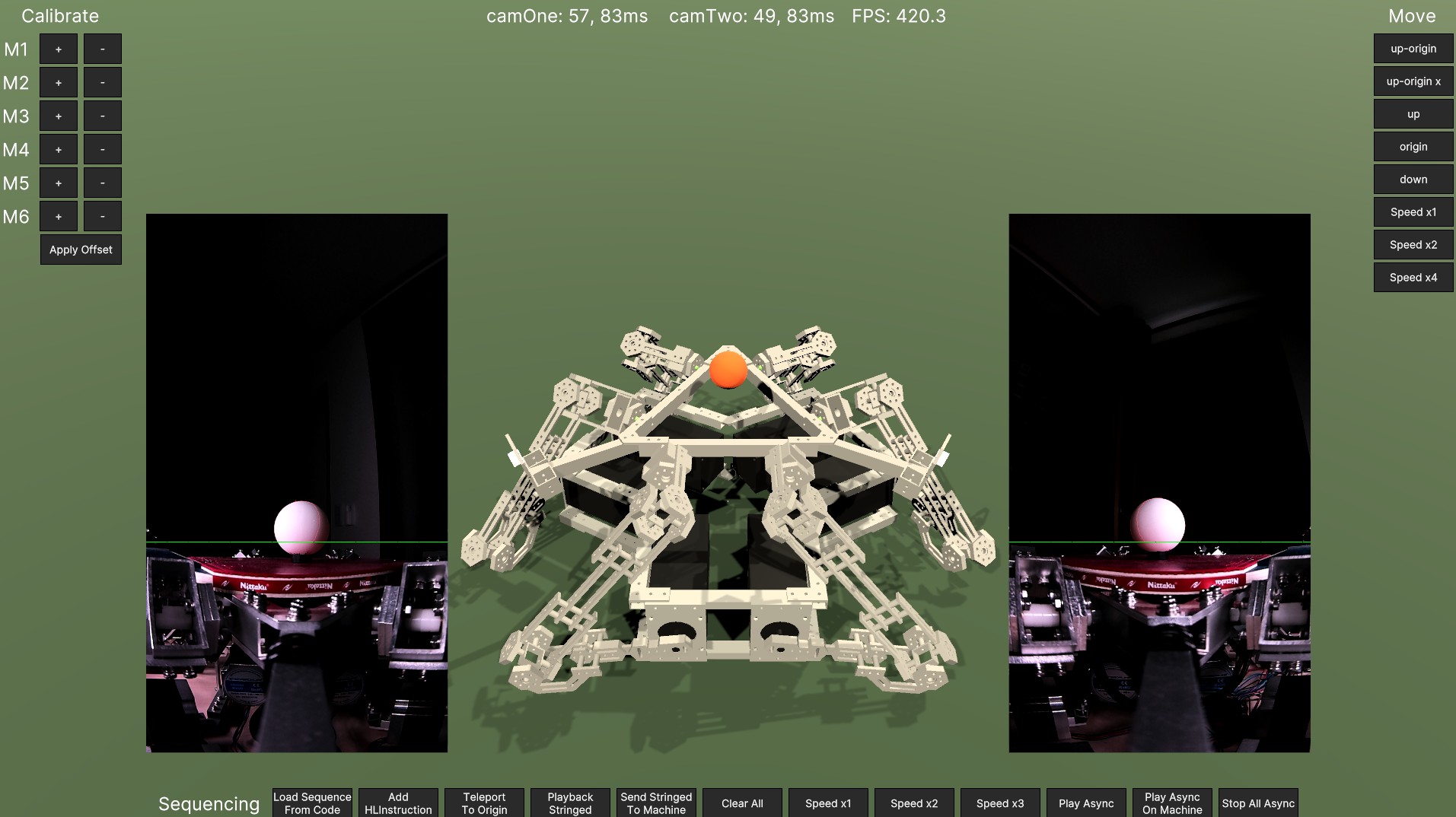
The maker community understands this gap intuitively, even if it rarely gets framed that way. Consider the 'Hexa-Bouncer,' the gloriously overengineered Stewart Platform project built with six stepper motors, planetary gearboxes, dual cameras, and over 300 machined aluminum parts, all in service of the modest goal of keeping a ping-pong ball bouncing. It's easy to laugh at the scale of the effort relative to the task, but that ratio is precisely the point. Simple physical manipulation, done reliably, is hard. It takes inverse kinematics, real-time vision feedback, and mechanical precision most consumer robotics can't yet afford at scale. The Hexa-Bouncer is a toy-sized preview of the same disproportion Northrop Grumman and CMU faced in orbit, and that humanoid robot makers face in your laundry room.
None of this diminishes what Gemini 4 Argon or similar foundation models represent. Shared physical reasoning layers that generalize across robot platforms are a genuine unlock, and they will accelerate everything downstream. But the industry's marketing instincts keep racing ahead of its mechanical realities. Benchmarks measure what's easy to measure: visual reasoning, planning accuracy, simulated physics prediction. They don't measure what breaks when a gripper meets a wet sock at an unexpected angle for the four hundredth time.
The companies that win the next decade of robotics won't be the ones with the smartest models alone. They'll be the ones willing to spend as much obsessive engineering effort on hands, joints, and grippers as Carnegie Mellon spent on a single peg-in-hole docking mechanism. Intelligence is necessary. It has never been sufficient.