
Why Are Robots Still Better at Badminton Than Caring for People?
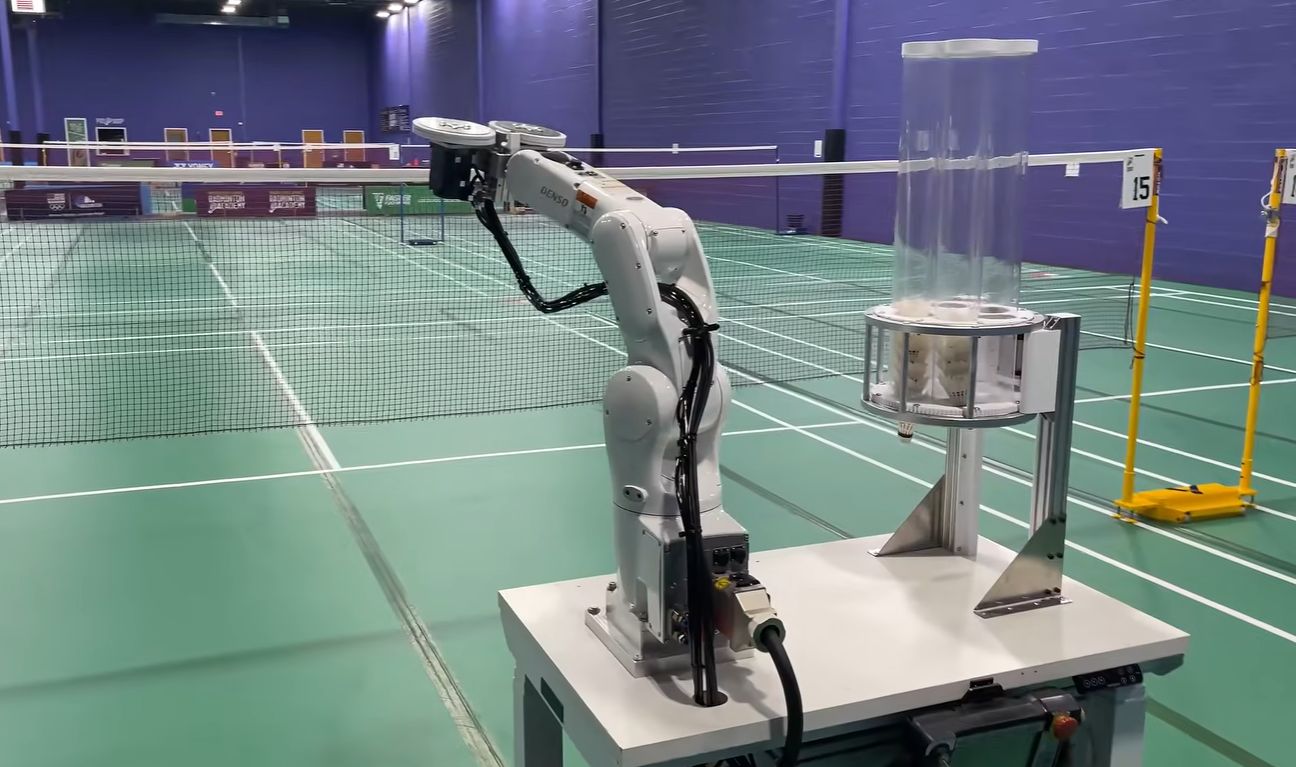
A BBC sitcom called Ann Droid is raising questions about whether robots can meaningfully address loneliness in elderly care. Meanwhile, NASA is preparing autonomous rovers that will make their own decisions on the Moon. And somewhere between these high-stakes applications, a hobbyist engineer just built a remarkably sophisticated badminton shuttlecock server in their workshop.
The contrast is striking. We have the technical capability to build robots that coordinate autonomously in one of the most hostile environments humans have ever explored. We have makers crafting complex pneumatic gripping systems and custom firmware for weekend projects. Yet when it comes to the intimate, messy work of human companionship and care, we're still asking whether it's even possible.
This isn't a technology problem. The robotic arm serving badminton shuttlecocks demonstrates considerable mechanical sophistication—custom 3D-printed metal parts, coordinated pneumatics, precise motion control. The Berkeley Humanoid Lite shows that capable humanoid platforms can now be built for under $5,000 using open-source designs. The technical barriers that once made personal robotics prohibitively expensive are crumbling.
The real barrier is that companionship robotics occupies an uncomfortable middle ground. It's too complex and unpredictable for the structured industrial applications where robots excel. It's too intimate and consequential to treat as a hobbyist curiosity. And it requires solving problems that can't be addressed through better actuators or more efficient path planning.
Consider what the Ann Droid discussion reveals: researchers are still examining whether machines can provide meaningful companionship at all. Not whether they can do it well, or affordably, or at scale—whether the fundamental concept makes sense. Compare this to lunar exploration, where the question isn't "should robots explore the Moon?" but rather "how do we make them autonomous enough to work without constant human oversight?"
The badminton robot and the microSD card library system highlighted this week share something important: they solve well-defined problems with measurable success criteria. Launch a shuttlecock at the right speed and angle. Move a card from slot A to slot B. These are tractable engineering challenges.
Companionship for isolated seniors is not a tractable engineering challenge in the same way. It requires navigating ambiguity, reading emotional states, adapting to individual needs that may be contradictory or unexpressed. It demands exactly the kind of flexible, context-aware intelligence that remains robotics' greatest unsolved problem.
Meta's data center robots, also in the news this week, represent the other end of the spectrum. Here's a use case with clear ROI, structured environments, and repetitive tasks. Cable management and server resets are perfect applications for current robotics capabilities. Of course Meta is deploying robots there.
The hobbyist community, meanwhile, keeps building increasingly impressive projects because they're motivated by the engineering challenge itself, not the business case. They can afford to spend months perfecting a badminton server because success is measured in personal satisfaction and community recognition, not quarterly returns.
Companionship robotics falls into the gap between these worlds. It needs the resources and scale that only large organizations can provide, but it's solving problems that resist the metrics-driven approaches those organizations require. It needs the creative problem-solving of the maker community, but at a level of reliability and safety that weekend projects rarely achieve.
Until we find a way to bridge that gap—or until loneliness becomes enough of a quantifiable crisis to justify the investment—we'll continue seeing remarkable robots that serve shuttlecocks while researchers still debate whether machines can meaningfully address human isolation. The technology isn't the bottleneck. Our ability to apply it to problems that actually matter is.