

Seed-Sized Surgery and Cycloidal Gearboxes: The Miniaturization Revolution Nobody's Talking About
The robotics community has a size problem — specifically, an obsession with human-scale machines. Flip through any industry coverage and you'll find endless coverage of humanoid robots, quadrupeds, and warehouse giants. Meanwhile, some of the most significant engineering breakthroughs are happening at scales that would fit in your pocket.
Consider the recent announcement from Nanyang Technological University: a 4.4mm surgical robot that performs five distinct functions. That's smaller than a pea, yet it can cut tissue, deliver drugs, grip samples, generate heat, and move through the body — all controlled remotely via magnetic fields. The engineering density here is staggering. Every cubic millimeter has to justify its existence. There's no room for redundancy, no space for "we'll optimize that later."
This isn't just impressive as a party trick. Miniaturization at this level requires fundamentally different approaches to actuation, power delivery, and control systems. You can't simply scale down a traditional robot arm and call it done. These constraints force genuine innovation.
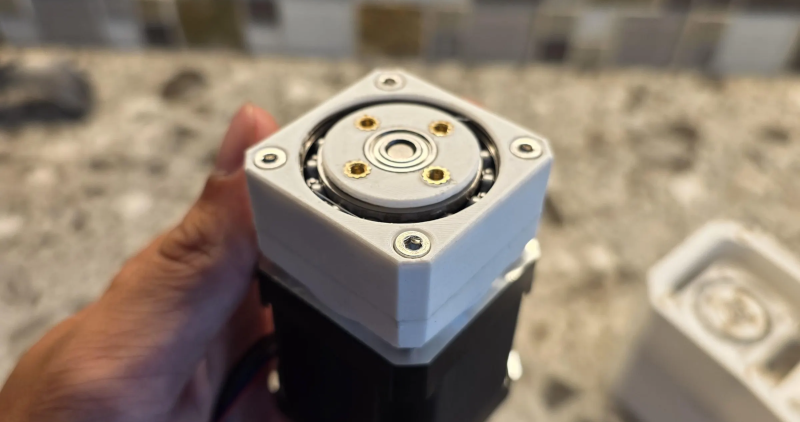
On the opposite end of this miniaturization trend, we're seeing hobbyists and small-scale manufacturers pushing similar boundaries. Take the VANTIX cycloidal gearbox, a fully 3D-printed design that matches the height of a standard NEMA 17 stepper motor axle. It's not trying to be everything to everyone — it's optimized for a specific form factor, using mostly printed components with press-fit assembly. The design philosophy is identical to that surgical robot: maximum capability in minimum space.
What connects these projects isn't just size. It's specialization. The seed-sized surgical robot isn't trying to be a general-purpose medical device. The cycloidal gearbox isn't competing with industrial servo systems. They're laser-focused on doing specific things exceptionally well within tight physical constraints.
Compare this to the current humanoid robot gold rush. Companies are racing to build general-purpose platforms that can "do anything a human can do" — a goal that's both technically ambitious and commercially questionable. How many warehouse operators actually need a robot that can also make coffee and climb stairs? The specialized AMR market, now projected to hit $14 billion by 2030, suggests that purpose-built solutions often win over Swiss Army knife approaches.
The miniaturization trend also reveals something about manufacturing maturity. When you can 3D-print a functional cycloidal gearbox at home or pack five surgical instruments into a 4.4mm package, it signals that the underlying technologies — additive manufacturing, magnetic actuation, embedded control systems — have reached a level of accessibility and sophistication that enables entirely new design paradigms.
This matters because the most transformative robots might not be the ones that look like us. They might be the ones that slip inside us, or the compact actuators that enable entirely new machine architectures, or the specialized designs that solve narrow problems brilliantly. The macro trends in robotics get the headlines, but the micro trends might be building the future.
The industry would do well to pay more attention to engineering at the extremes. When researchers can pack multifunctionality into a seed-sized package or hobbyists can print precision gearboxes in their garage, it suggests we're entering an era where physical constraints inspire creativity rather than limit it. That's worth more than another humanoid demo video.