
Robots Are Starting to Feel Their Way Through the World
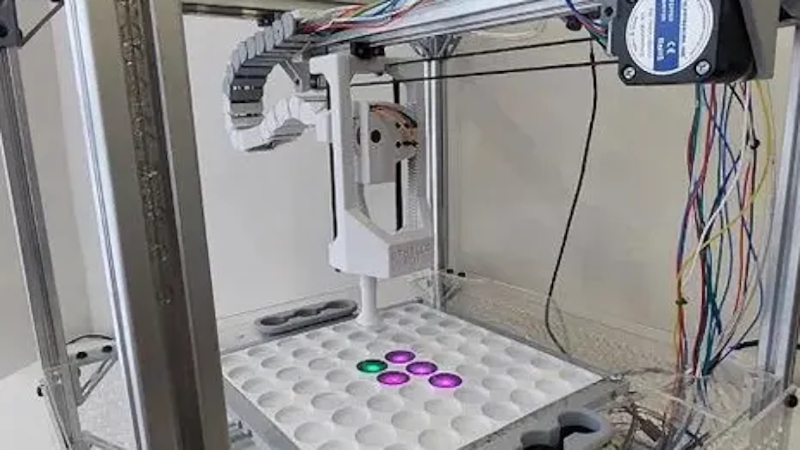
While most of this week's robotics headlines were dominated by OpenAI's expanding empire of partnerships and acquisitions, two smaller research stories deserve more attention than they're getting. Carnegie Mellon's "Wiggle and Go" system teaches robots to estimate the physical properties of ropes and cables by observing how they respond to a brief initial perturbation—no trial-and-error required. Meanwhile, researchers at the University of Bristol built a physical model using electric motors to show that coordinated, muscle-like behavior can emerge naturally from mechanical setup alone, without explicit programming. Taken together, these studies hint at a meaningful shift in how roboticists are approaching one of the field's oldest problems: how does a machine understand a physical world it has never encountered before?
For decades, the dominant paradigm has been to either hand-engineer physical models (which are brittle and don't generalize) or throw massive amounts of trial-and-error reinforcement learning at the problem (which is slow, expensive, and often impractical outside simulation). Both approaches have real limits when a robot encounters a genuinely novel object—a tangled cable, an unfamiliar fabric, an oddly weighted tool. CMU's insight is elegantly simple: a single, deliberate wiggle can reveal enough about a rope's stiffness and dynamics to plan a manipulation strategy, sidestepping the need for thousands of failed attempts. It's the robotic equivalent of a human picking up an unfamiliar object and giving it a quick shake before deciding how to hold it.
The Bristol muscle research points toward something subtler but equally consequential: that some of the "intelligence" we associate with coordinated movement doesn't have to live in a control algorithm at all—it can be baked into the mechanical structure itself. If coordination emerges from how motors and linkages are physically arranged, that shifts part of the computational burden away from software and onto hardware design. This has real implications for the broader push toward dexterous, soft, and bio-inspired robotics, a theme echoed elsewhere this week in Robot Talk's interview with Zlatka Stoeva of DZP Technologies, whose work on flexible, stretchable printed electronics is aimed at exactly this kind of embodied intelligence.
Why does this matter now? Because the industry's attention—and capital—is overwhelmingly focused on large language models and agentic software, as this week's flood of OpenAI announcements makes clear: Codex acquisitions, enterprise partnerships with ServiceNow and Cisco, new government deployments, expanded bug bounties. All of that is important, but none of it solves the much harder problem of getting a robot to competently handle a cable, a garment, or an unfamiliar tool in someone's kitchen. The gap between language intelligence and physical intelligence remains enormous, and it's physical intuition—efficient, low-data, mechanically grounded—that will determine whether robots can leave structured factory environments and function in homes, hospitals, and disaster zones.
CMU's new 150,000-square-foot Robotics Innovation Center, opened this week in Pittsburgh, is a reminder that this unglamorous, slower-moving research still has institutional champions willing to bet on it. The humanoid robot hype cycle will keep generating headlines, but the quieter work of teaching machines to understand physics with a single wiggle may ultimately prove more foundational to robotics' next decade than any chatbot integration.