

Nobody Wants to Talk About the Hard Part of Robotics
This week's AI news cycle delivered its usual parade of milestones: Gemini 4 Carbon topped benchmarks, GPT-6 Cyber promised to patch vulnerabilities before humans even notice them, and OpenAI rolled out Control Room to keep its own infrastructure in check. These are genuinely impressive feats of engineering, and they move fast. A new frontier model ships, gets integrated into airline chatbots and investment research tools within days, and the narrative writes itself: AI is advancing at a blistering pace.
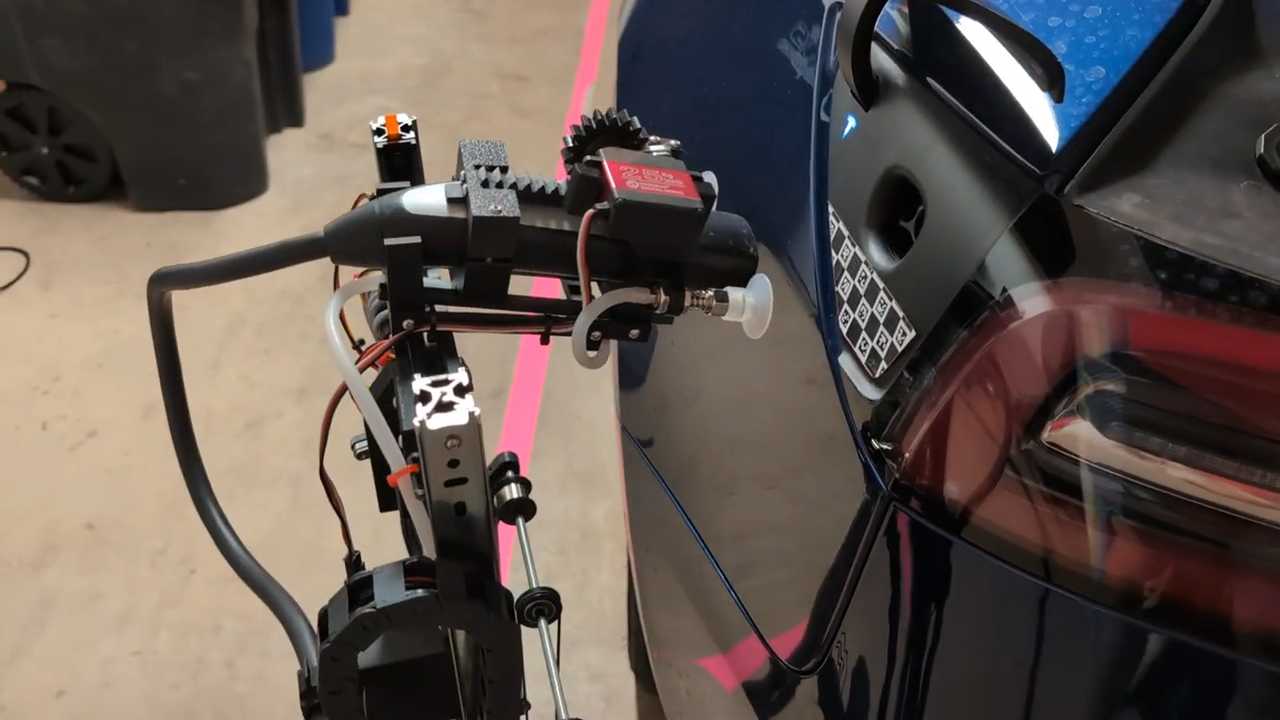
But tucked into the same news cycle was a very different kind of story, one that's easy to scroll past: a maker-built robotic car charger that uses Mecanum wheels, LiDAR, and suction cups to plug itself into an electric vehicle. It's a charming hack, and also a quiet reminder of something the software world tends to forget — making a machine reliably touch, grip, and align with a physical object in the real world is still an open engineering problem that hobbyists are solving with suction cups and gear assemblies, not foundation models.
That contrast is the real story of the week. The 2026 AI100 longitudinal report explicitly names embodied AI and physical intelligence as a 'grand challenge,' even while acknowledging genuine progress in vision-language-action models and simulation. Meanwhile, Team Chiron — a Carnegie Mellon, Pitt, and Lockheed Martin collaboration — is fielding autonomous drones and ground robots in the DARPA Triage Challenge finals, trying to get machines to find and assess injured people in mass-casualty scenarios. And over at the University of Sussex, researcher Dexter Shepherd is still working on the basics: bio-inspired tactile sensing, teaching robots to classify textures and adjust locomotion using reinforcement learning, the kind of granular sensorimotor work that doesn't make headlines but underpins everything a humanoid robot needs to do once it leaves a demo stage.
The juxtaposition matters because it exposes a structural truth about where AI progress is easy and where it's hard. Language and code live in a forgiving medium: text can be generated, scored, and corrected in milliseconds, at scale, with no physical consequences for failure. A hallucinated API call costs nothing but a retry. A robot that misjudges the friction of a charging port, the weight distribution of a patient on a stretcher, or the give of human skin under a probe can cause real damage, or simply fail outright, in ways that no amount of benchmark tuning fixes overnight.
This is also why AIhub's recent 'coffee corner' discussion on whether humanoids are the future of embodied AI is more consequential than it sounds. The panel's conclusion — that hardware, learning-based control, and sim-to-real transfer have all genuinely improved — is true. But the gap between a humanoid folding laundry in a controlled RoboCup demo and a humanoid doing triage in a collapsed building, or confidently docking a charging connector on a moving car in the rain, remains enormous. Progress in embodied AI isn't measured in benchmark leaderboard rankings; it's measured in thousands of unglamorous repetitions where a gripper slips, a sensor misreads a texture, or a suction cup fails to seal.
None of this is an argument against the current software boom. Tools like AlphaProof Code verifying encryption libraries, or Mitra-v2 handling messy business tables, are valuable precisely because they operate in digital domains where correctness can be formally checked. But the industry would do well to resist collapsing 'AI progress' into a single narrative of ever-larger models. The car charger, the triage robots, and the tactile sensing research are the unglamorous, essential groundwork — and they're a better predictor of how soon robots will actually share our physical world than any benchmark chart.